
The Agentic Operator: How to Lead When Half Your Team Is AI

The Question Every Operator is Being Asked Right Now
If you run operations at a growth-stage company in 2026, you already know the question. It comes from the board. It comes from your CEO. It comes from the head of marketing who saw a
demo. It comes from the new VP of engineering who needs to look like they're "ahead of it."
What are we doing about agentic AI?
You have two acceptable answers, and both of them are wrong.
Move fast. Spin up an AI council. Hire a head of AI. Buy the platform. Announce the strategy at the all-hands. The board claps. Three months later your customer NPS is down nine points, your best ops manager has quit, and the agent that was going to "transform" billing is making mistakes a junior would catch on day one.
Move slow. Talk about safety. Talk about culture. Talk about doing it right. Six months later your board deck has a slide that calls you a "thoughtful adopter." Everyone in the room nods. Then someone forwards you an article about a competitor that just cut 30% of their CX headcount and you spend the weekend staring at the ceiling.
Neither answer is the operator's answer. The operator's answer doesn't exist in the playbooks you've been handed. It's the one you're going to have to build, and the thing you build it with is the most undervalued asset in your company right now: your judgment.
That's what this piece is about.
Why the Standard AI Playbooks are Failing You
Read enough of the AI transformation content and a pattern shows up. The frameworks all look professional. The decks are clean. The recommendations are confident. And almost none of them are written by someone who has ever run a P&L, missed a quarter, or had to tell a long-tenured employee that their role is changing.
The playbooks tell you to build an AI council. They don't tell you who chairs it, what its decision rights are, or what happens when the head of CX says "no" and the head of engineering says "ship it."
They tell you to hire a head of AI. They don't tell you what that person reports on in month six when nothing has gone to production.
They tell you to run a "transformation." They don't define what's being transformed, by when, with what resources, and to what measurable result.
They tell you to be a fast follower. Fast follower of what? The companies publicly talking about their AI rollouts are either selling AI or running PR, and the ones quietly making it work aren't on stage.
The playbook isn't broken. It's pointed at the wrong problem. You don't have an AI problem. You have a judgment-allocation problem. You have a hundred decisions a quarter about where machine pattern-matching belongs and where human judgment has to stay in the loop, and no one is going to hand you a generalized rubric for that. The ones who try are usually the same people who told you in 2014 that "data-driven culture" was a strategy.
Your judgment is the strategy. The playbooks fail because they're pretending that's not true.
The Reframe: Your Unease is Pattern Recognition, Not Weakness
I wrote a book last year called Lead Anyway. It's structured as a six-week workbook of leadership truths to reclaim. The last truth is the one most people screenshot.
The reframe is this. Impostor syndrome isn't a personal failing. It's pattern recognition that you don't have language for yet. The unease you feel when you walk into a room you "shouldn't" be in is almost never weakness. Usually it's signal.
The book gives you a four-bucket diagnostic for that unease.
- Missing skill. There's a specific competency you don't have, and you can name it. This is the easy one. Go acquire it.
- Missing resource. The reason this feels wrong is that you're being asked to deliver without budget, time, headcount, or air cover. The unease is honest. Name the resource gap out loud.
- System wasn't built for you. The frameworks, metrics, or norms in the room assume a default operator who isn't you. The unease is data about the system, not about you.
- Wisdom signaling stakes. You've seen this movie before. Your gut is telling you the move on the table is going to hurt people or break something you can't unbreak. The unease is your judgment talking. Listen.
Now run that diagnostic on the AI decision in front of you this week.
The reason you hesitated to greenlight the customer-service agent isn't fear. It's almost never bucket one. It's bucket three (the rubric for "good enough" was written by someone who's never had to apologize to a customer), or bucket four (your gut knows the failure modes the vendor's demo didn't show you).
Your unease about AI on your team isn't weakness. It's the same operator pattern recognition that got you the seat you're in. The job isn't to override it. The job is to name what bucket you're in and act accordingly.
The Six Truths of the Agentic Operator
The book's six truths translate directly onto the AI moment. Here's how each one shows up for the operator running hybrid teams in 2026.
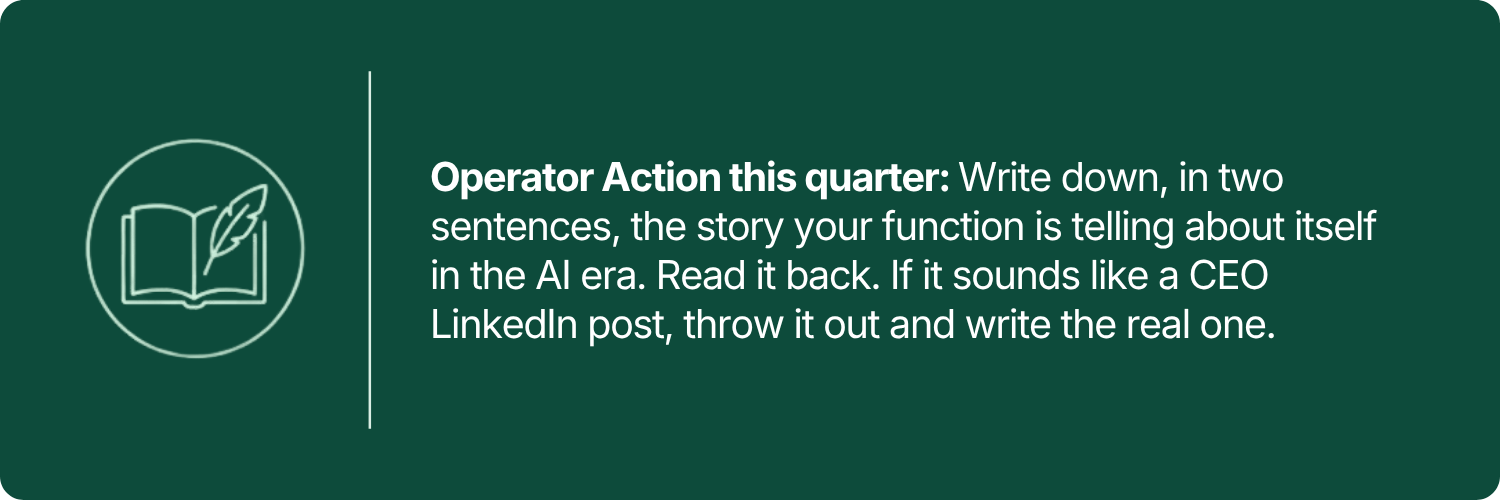
1. Own your operating story, not the AI hype cycle's.
The story you tell about your function is the foundation of every AI decision you make. If the story is "we are a fast-follower org that adopts what the market validates," every pilot you greenlight will be too late. If the story is "we are a quality-first org that uses AI to protect the experience our customers pay for," you'll know exactly which pilots are on-mission and which ones are theater.
2. Translate your operating skills. Everything you've built is transferable.
Every operator I know who is anxious about AI is anxious because they think their job is being redefined into something they haven't trained for. It isn't. Your job is still the same job. You allocate resources against outcomes. You read patterns in process and people. You decide what's worth a meeting and what gets a Loom. Hybrid teams don't require a new skill set. They require the skill set you already have, applied to a team that has new members in it.
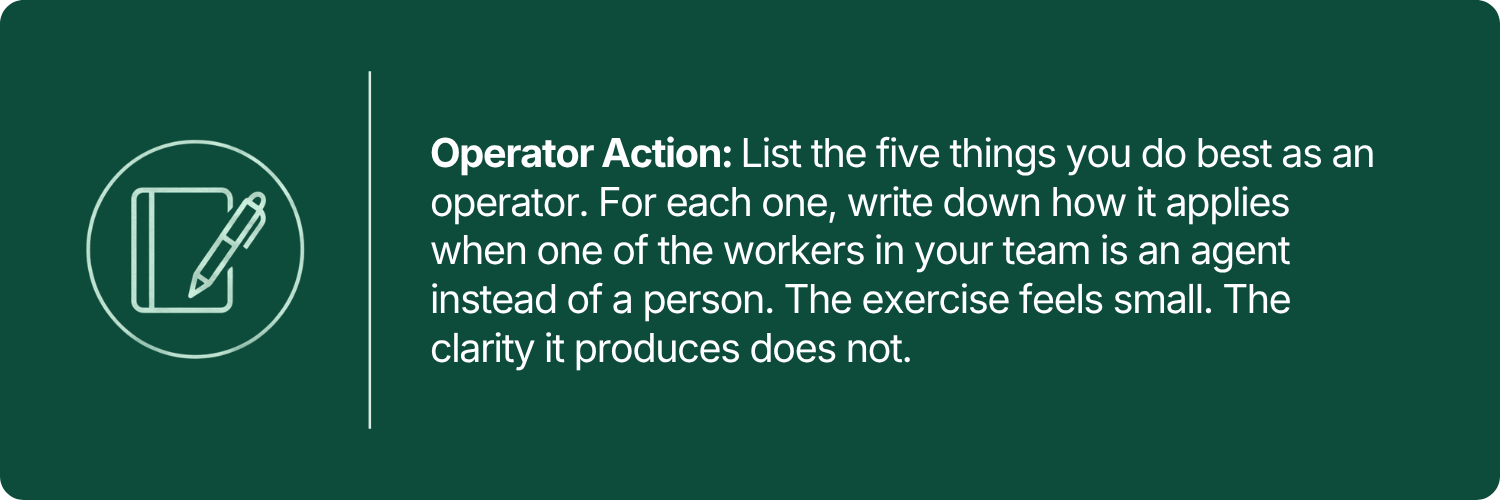
3. You're not behind on AI. You're early on judgment.
The companies racing to "lead" on agentic AI are mostly running expensive science experiments in public. You're not behind because you haven't shipped a customer-facing agent yet. You're early on the harder problem, which is figuring out where agent judgment ends and human judgment begins, and codifying that for your team in a way that won't blow up in production.
The leaderboard you think you're losing on doesn't matter. The one that matters is the one no one is publishing: which operators built a pattern-versus-judgment map for their function and used it to drive real margin. That race is still wide open.
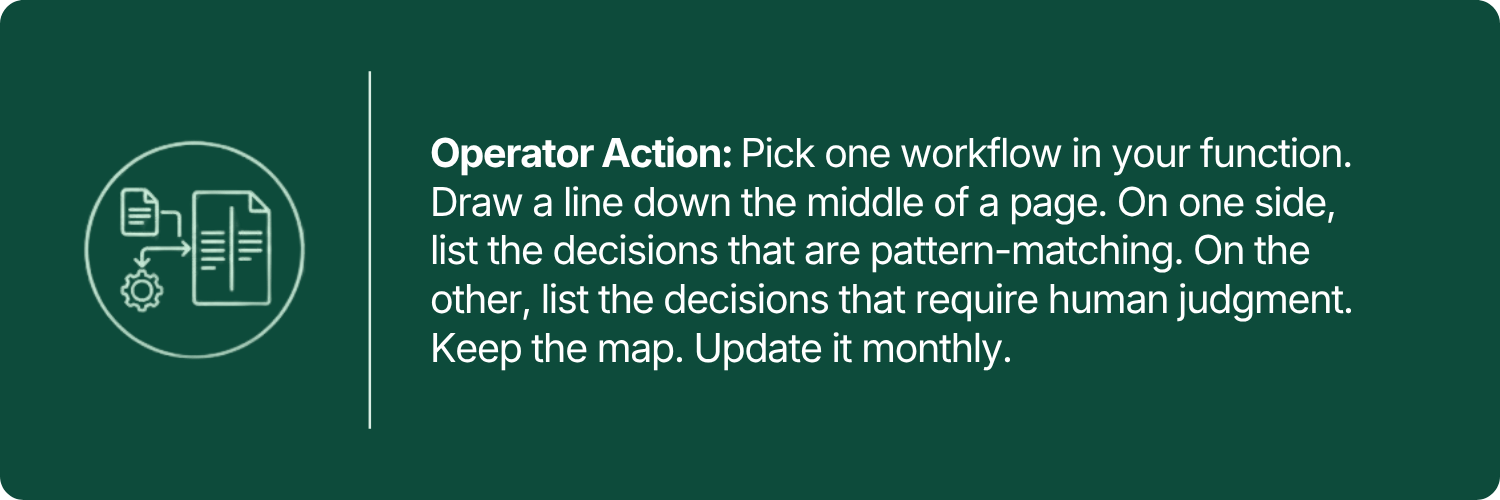
4. Start the pilot before you're ready.
Readiness is a trap. There is no version of the world where your data is clean, your team is aligned, your vendor is proven, and the stakes are low. If you wait for that version, your competitor's quarterly report will introduce you to it.
What courage actually looks like at the operator level is small, contained, observable experiments with clear kill criteria. Not a transformation. Not a moonshot. A 48-hour test. One workflow. One owner. One agent. One success metric. If it works, scale. If it doesn't, kill it cleanly and write down what you learned so the next bet is faster.
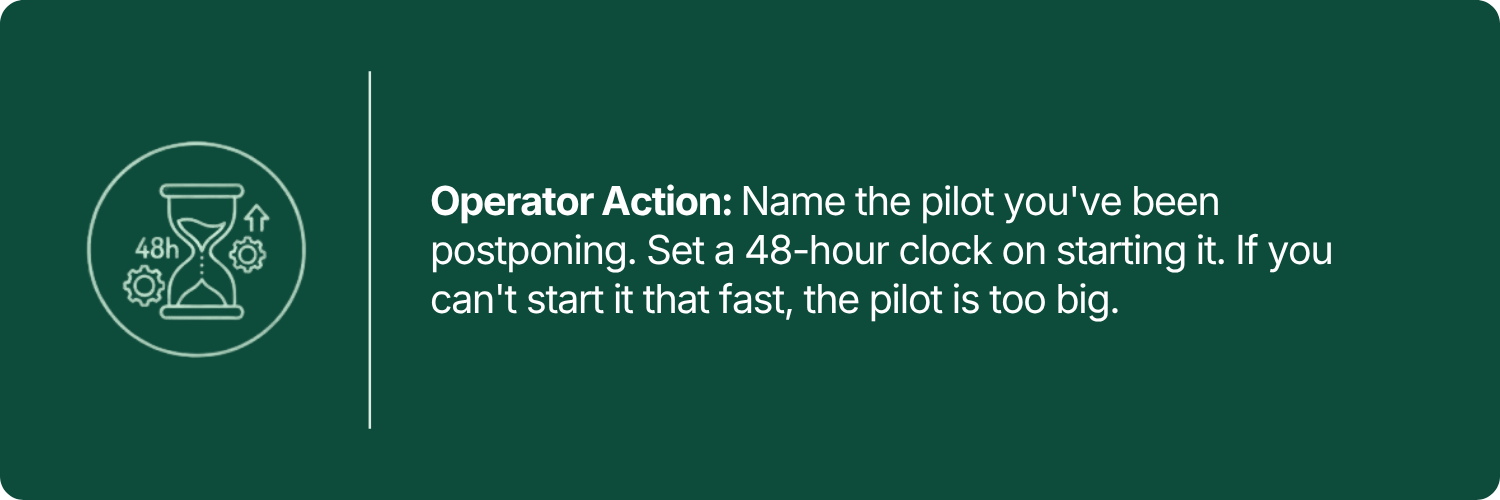
5. Find your operator voice in the AI room.
Most rooms where AI strategy gets set are full of people whose primary job is to sound confident about AI. Yours isn't. Your job is to know your operation and represent it accurately. That makes you the quietest authority in the room and the most important one.
The trap is letting volume win. The technologist will be louder. The consultant will be more polished. The board member who read three articles will be more certain. None of them have to live with the consequences of the decision. You do. That asymmetry is your authority. Use it.
6. Your unease about AI is data, not deficit.
This is the reframe from earlier, applied. When the discomfort shows up, don't suppress it and don't apologize for it. Sort it.
-
Is the discomfort a missing skill (bucket one)? Go acquire the skill, or hire someone who has it.
-
Is it a missing resource (bucket two)? Name the gap in writing, and refuse to ship until the resource is real.
-
Is it the system not being built for your operation (bucket three)? The unease is feedback for the framework, not for you. Tell the framework owner.
-
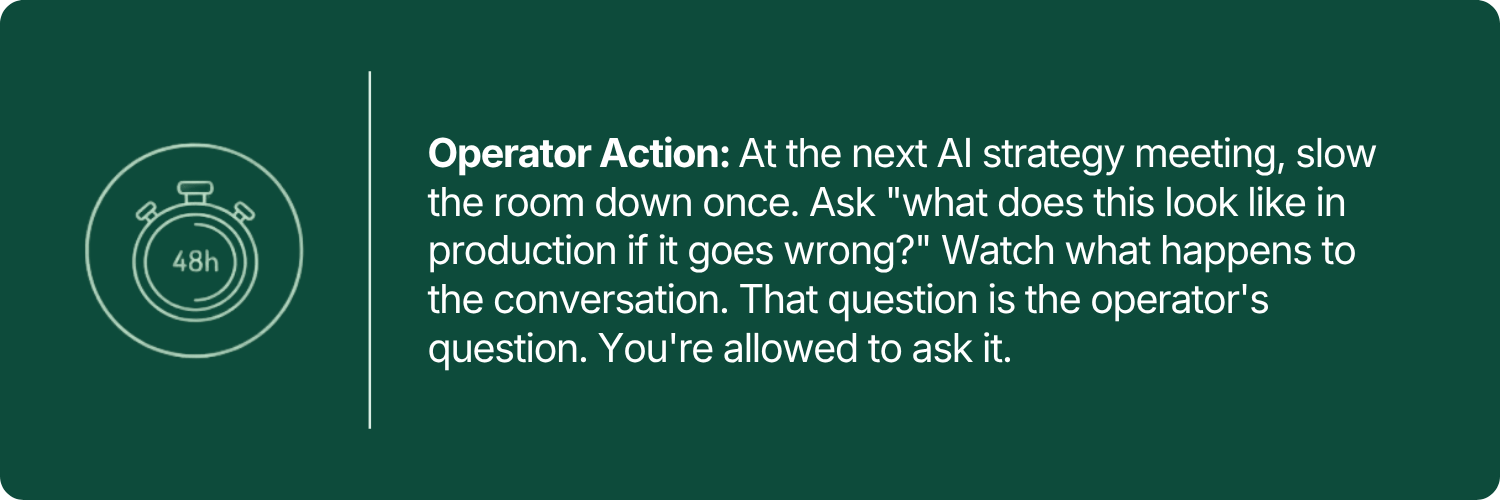
Is it wisdom about the stakes (bucket four)? Slow the room down. Your judgment is the most expensive thing in the building. Spend it.
That's the Agentic Operator's diagnostic. Six truths, one underlying move: trust your operator pattern recognition, and lead with it on purpose.
The 48-Hour Test
If you read this far, you don't need another framework. You need a clock.
The Agentic Operator doesn't read another white paper before they decide. They run a 48-hour experiment. One workflow they actually own. One owner accountable for the result. One agent doing one job. One success metric written down in advance.
48 hours is the unlock for a reason. It's short enough that you don't need a steering committee. It's long enough to learn something real. It's small enough that if it fails, nothing breaks. And it's the antidote to the most expensive habit operators have in this moment, which is reading and convening and waiting until "we have a strategy" before anyone runs a real experiment.
Your strategy is downstream of your experiments, not upstream of them. The operators who will lead this era well are running their first ten 48-hour tests in 2026. The ones who will lose it are reading their eleventh framework.
Pick the workflow. Set the clock. Start.
Lead Anyway
I called the book Lead Anyway for a specific reason. Every operator I've ever worked with has had a moment where they're told to wait. Wait until the strategy is ready. Wait until the rules are clearer. Wait until the playbook gets written. Wait until permission gets handed down from someone who has never sat in your seat.
This is your permission slip. You are not behind. You are not unqualified. You are not the wrong person for this moment. You are the operator. The pattern recognition that got you here is the most valuable thing on your team right now, and the AI moment is asking you to use it on purpose.
Lead your operation your way. Lead it before the playbook catches up. Lead it because your judgment is the strategy.

About the Author:
Jen Spencer is the Chief Growth Officer at Booth, where she helps growth-stage companies build hybrid human-AI teams without compromising on quality, culture, or control. She's the author of Lead Anyway: How to Build the Career You Want When the Rules Weren't Written for You, a six-week workbook on reclaiming leadership in rooms that weren't built for you. Before Booth, Jen was the CEO of a 300-person digital agency. She advises and invests in early-stage SaaS, is a Pavilion member, and speaks on operations strategy in the AI era. Author. Operator. Recovering impostor.


