
AI and Marketing Jobs: Which Skills Matter Now

Same job titles. Very different jobs. Here’s what’s actually shifting in marketing, and the skills coming out ahead.
Short Answer
AI isn’t replacing marketing jobs, it’s raising the bar on the skills they require. The B2B marketer of tomorrow blends data fluency and AI-enabled execution with the human skills employers now prize most: communication, collaboration, creativity, adaptability, and strategic thinking.
Take a fresh look at a marketing job posting today and you’ll notice how much the role has grown. The titles are familiar: marketing manager, content strategist, demand gen lead. But the skills listed underneath them have evolved. The headline stayed the same. The job moved forward.
There’s real data behind that shift. As Karin Kimbrough, chief economist at LinkedIn, explains in The future of marketing jobs in the age of AI: “AI is reshaping the skills required for marketing rather than replacing marketing jobs.” In other words, the roles aren’t going anywhere. But what they ask of you is expanding fast.
So what are employers looking for now? More than someone who can run a campaign or keep the content calendar full. They want marketers who can read the data, work alongside AI, and tie all of it back to the outcomes the business cares about most. The modern marketer is a bit of a hybrid: part creative, part analyst, part AI wrangler, and a stronger communicator than ever.
The Marketing Skills Defining the Role Now
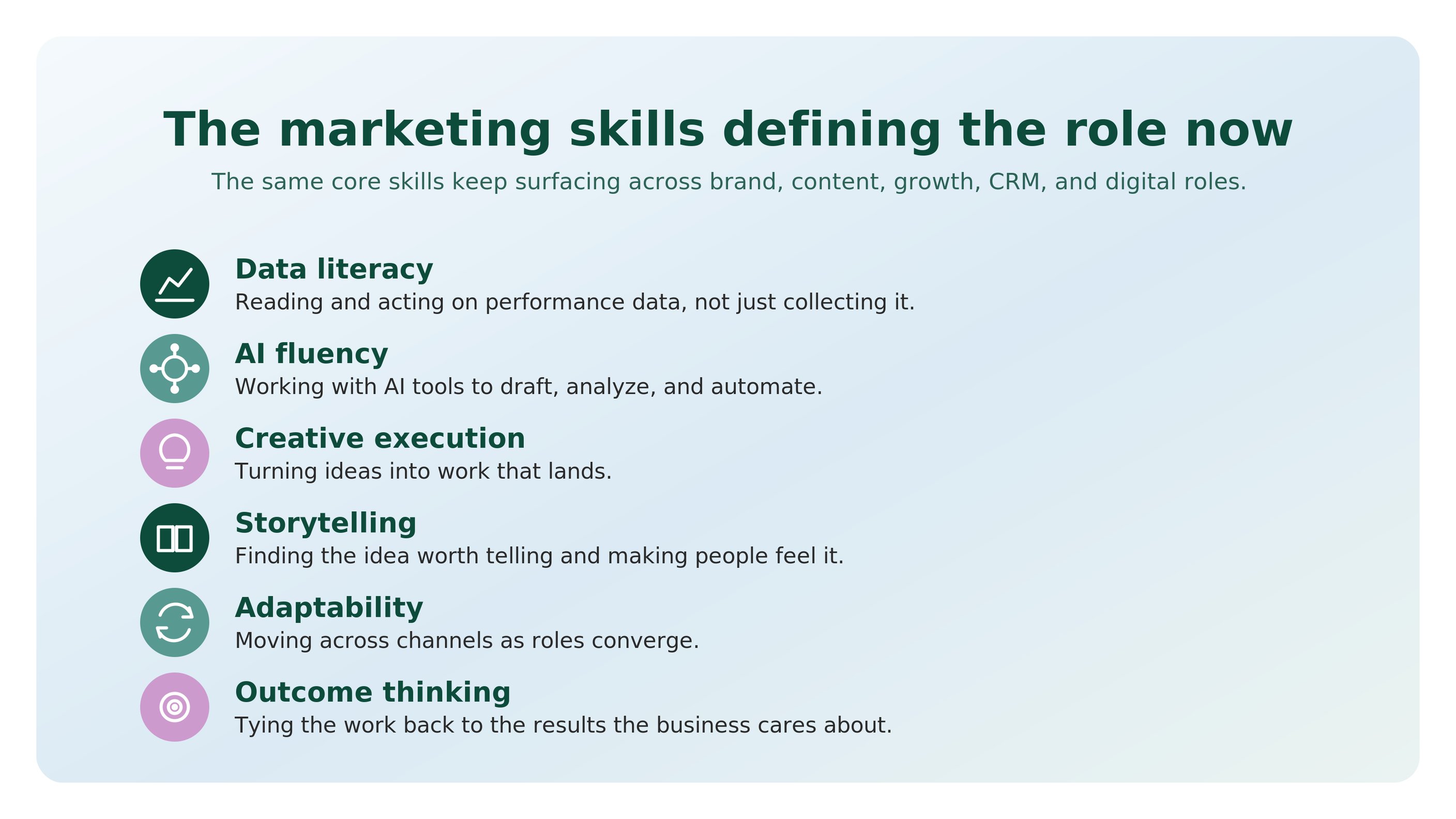
Across brand, content, growth, CRM, and digital roles, the same core skills keep surfacing in job postings:
- Data literacy: reading and acting on performance data, not just collecting it
- AI fluency: working with AI tools to draft, analyze, and automate
- Creative execution: turning ideas into work that lands
- Storytelling: finding the idea worth telling and making people feel it
- Adaptability: moving across channels as roles converge
- Outcome thinking: tying the work back to the results the business cares about
WHY MARKETING ROLES ARE CONVERGING
The Neat Little Swimlanes are Gone
The content marketer made the content. The performance marketer ran the optimization. The analyst owned the spreadsheets. Everyone stayed in their swimlane, and it worked. Those lanes have mostly washed away.
Now it barely matters whether the role says brand, content, growth, CRM, or digital. Employers want people who can move across all of it. Creative thinking, analytical chops, and AI-enabled execution, ideally in the same person. Nobody expects you to moonlight as a data scientist. You just need enough fluency to work with the tools without breaking into a cold sweat.
IS AI REPLACING MARKETING JOBS?
Your Sidekick, Not Your Stand-In
No. What’s really happening is a reshuffle of the work itself. It’s easy to flatten the AI conversation into one question: is it coming for marketing jobs or not? The reality is more useful than either answer. Picture every task a marketer does sitting somewhere on a grid: high-volume, repeatable work on one end; high-context, judgment-heavy work on the other. AI and automation are quietly taking over the repeatable end: list enrichment, reporting, first-draft copy, and campaign QA. That’s real, and some of those tasks won’t come back to a person’s plate.
But here’s the part that matters for your career: that’s the bottom of the value ladder, not the top. The work that’s hardest to automate, strategy, brand, the judgment calls, is exactly the work most marketers never have enough time for. AI is at its best as a sidekick, not a stand-in. Hand it the repeatable work, and you get those hours back for the thinking you were actually hired to do.
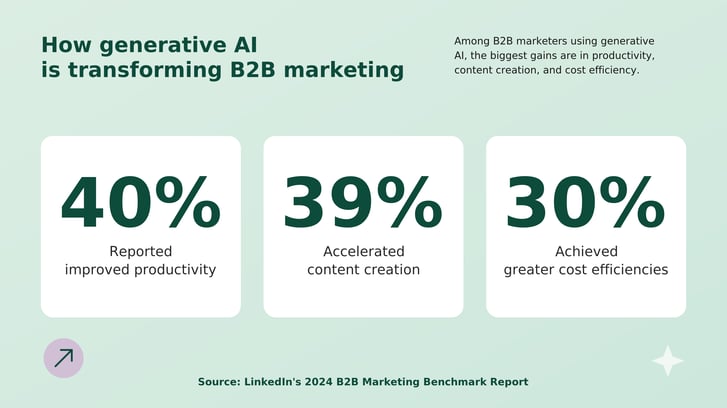
The data backs the optimism. According to LinkedIn’s 2024 B2B Marketing Benchmark Report, among B2B marketers using generative AI:
- 40% reported improved productivity
- 39% accelerated content creation
- 30% achieved greater cost efficiencies
The takeaway isn’t that AI is replacing marketers. It’s that marketers who know how to work with AI are gaining a meaningful competitive advantage.
WHICH MARKETING SKILLS ARE HARDEST TO AUTOMATE?
The Edge is Human
The more AI takes over the repetitive work, the more valuable uniquely human skills become. For most of history, work rewarded muscle. The last few decades rewarded specialized knowledge and technical expertise. As AI takes on more routine cognitive tasks, the advantage is shifting once again toward capabilities that technology struggles to replicate.
Communication, empathy, adaptability, creativity, storytelling. We file these under “soft skills,” which is a wild undersell. They’re the part of the job you defend, because they’re the part that’s irreplaceable. Storytelling is the obvious one: when anyone can spin up a draft in ten seconds, the marketer who finds the idea actually worth telling, and makes people feel it, is the one who gets remembered. It’s no accident that communication now ranks among the most in-demand skills on LinkedIn, or that the top skills for B2B marketing leaders skew relational. Brand, buyer relationships, and the hard calls: that’s the work to protect and build.
HOW MARKETERS AND EMPLOYERS SHOULD RESPOND
So What Do You Actually Do With This?
For marketers, this is an opportunity. Get comfortable with AI tools, learn to actually read your data, stay curious about the tech, and your options widen across every flavor of marketing role. Your foundational skills still matter. They’re just not the whole résumé anymore.
For employers, it’s a nudge to hire and build a little differently. Your best candidate might not tick every box on the job description. Look for the ones who can connect creative execution, analytical thinking, and AI-driven workflows, then give them the tools to work at the top of their value ladder instead of the bottom. That’s the profile worth betting on, and it’s the model worth building around: smart tools doing the repeatable work, sharp people doing the thinking.
THE BOTTOM LINE: SKILLS OVER TITLES
It Was the Skills All Along
This was never creativity versus technology. It’s both. And the thread tying them together is skills. The tools will keep changing. Customer expectations will keep climbing. The marketers who win are the ones who keep building on both sides: the technical fluency to work with AI, and the human skills it can’t fake. Titles will keep shifting under your feet. Skills are the thing that holds its value. The playbook is changing, so keep yours changing with it.
Ready to put these skills to work? Explore careers with Booth.
We place and grow talent across 120+ countries, connecting businesses with exceptional talent and professionals with careers that last. Building a future-ready team instead? See how Booth can help.
About the Author:
Booth is a people-first outsourcing and talent solutions company that helps growing businesses build and manage remote teams across the Philippines, Colombia, and beyond. A Certified B Corp, member of 1% For The Planet, and Change Climate certified, Booth pairs skilled talent with transparent, accountable execution to deliver growth without compromise.


