
Booth vs. Remote vs. Emapta: EOR vs. BPO for HIPAA-Compliant Healthcare Operations

Booth vs. Remote vs. Emapta: Overview
What is Booth?
Booth is a people-first managed outsourcing and talent solutions company for organizations that need HIPAA-ready back-office support. With 1,700+ professionals in Manila, Cebu, and Bogotá, Booth offers two models: Talent Solutions, where Booth employs and supports your dedicated team members while you direct their daily work, and Managed Solutions, where Booth runs the entire function — hiring, training, QA, and reporting — against your KPIs. Booth operates secure facilities with RFID entry controls and role-based system access, signs Business Associate Agreements (BAAs), and runs security controls aligned to ISO 27001.
Booth Key Features
- HIPAA-ready operations: BAAs in place, secure delivery centers with RFID access controls, role-based permissions, and multi-site continuity across Manila, Cebu, and Bogotá.
- Two engagement models: Client-directed dedicated teams (Talent Solutions) or fully managed functions with KPI ownership (Managed Solutions), switch or combine as you scale.
- Outcome-based pricing: For high-volume managed work, Booth bills per transaction or conversation, not per FTE. Costs move with your volume; Booth absorbs the capacity risk.
- KPI accountability with credits: In Managed Solutions, your service levels are Booth's service levels. Miss them, and Booth credits you.
- AI-augmented delivery: Booth's AI layer, including RubriCore quality assurance, handles volume while people handle judgment — QA coverage on interactions, not samples.
- 90% annual retention: Booth retains 90% of team members annually, against BPO industry turnover that commonly runs 30–40%.
- BoothOS platform: one dashboard for onboarding, payroll, contracts, and benefits, with global hiring reach across 120+ countries.
- Certified B Corporation, Climate Label Certified, and 1% for the Planet member: third-party-verified commitment to fair wages, responsible growth, and a carbon footprint measured and offset every year since 2021.
- Transparent pricing: monthly fee equals talent compensation plus a management fee. No hidden markups.
Booth Pros and Cons
Pros:
- You choose the model per function: direct management of dedicated team members or a fully managed function with KPI credits — most providers force one or the other.
- Bogotá covers the full U.S. business day, Central time most of the year and Eastern from November to March, for real-time collaboration; Manila enables follow-the-sun and 24/7 coverage.
- Recruiting is included. Booth sources, vets, and culture-matches candidates rather than asking you to bring your own.
- Outcome-based pricing means high-volume functions can be billed per unit of work. Costs scale with your business, not your headcount.
Cons:
- Booth is a service relationship, not self-serve software. Booth handles engagements from a single international hire up, but buyers who want a pure swipe-a-card platform with no human in the loop may prefer a software-only tool.
- Delivery hubs are concentrated in the Philippines and Colombia; organizations requiring on-the-ground delivery teams in Europe or Africa will need Booth's global hiring platform rather than a Booth-run facility.
- Typical ramp for a new team is 30 to 60 days, including recruiting, screening, and compliance onboarding — plan capacity ahead rather than overnight.
What is Remote?
Remote is a global employer of record platform for companies hiring internationally without local entities. Remote states that it owns its legal entities in the countries it serves — no third-party partners in the employment chain — and provides EOR services in 90+ countries, contractor management in 200+ jurisdictions, and payroll in 100+ countries. Healthcare organizations use Remote to legally employ international staff; Remote handles contracts, payroll, tax withholding, and statutory benefits.
Remote Key Features
- Owned-entity EOR model: Remote states it owns and operates 100% of its EOR entities, with no third-party partners in the employment chain. The claim is self-reported and unaudited.
- Global payroll and contracts: locally compliant agreements, tax filings, and statutory benefits across its coverage map.
- Contractor management: onboarding and payment for contractors in 200+ jurisdictions, with misclassification protections.
- Self-serve platform: HR teams manage hiring, contracts, and payroll in-app, though EOR onboarding still runs through a dedicated implementation manager and a named CSM.
- IP and invention protections: structured IP assignment built into employment agreements.
Remote Pros and Cons
Pros:
- Owned entities in every EOR market mean consistent service and clear legal accountability.
- Strong self-serve experience for teams that want software, not services.
- Broad geographic reach across 90+ EOR countries.
Cons:
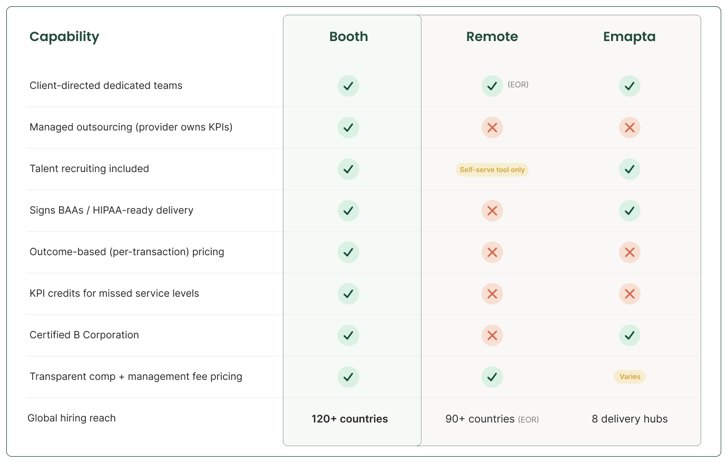
- Employment administration only, no managed outsourcing. Remote sells employment administration, from EOR and payroll to PEO and contractor management, but never a function run against KPIs.
- Recruiting is self-serve software, not a service. Remote Recruit sells AI sourcing, a job board, and a built-in ATS as a paid add-on, but no recruiter runs a search for you, and no shortlist arrives.
- No healthcare specialization. Remote's support center states that business associate agreements are "not required under HIPAA in relation to the employment services we provide" and does not offer to sign one. Remote's trust center lists SOC 2 Type 2, ISO 27001, GDPR, and CSA STAR — not HIPAA. No healthcare-trained talent pools, no HIPAA-specific delivery infrastructure.
What is Emapta?
Emapta is an outsourcing and dedicated staffing company with EOR services, operating eight delivery hubs and rooted in the Philippines. Emapta builds dedicated teams across industries, including healthcare — medical billing, claims processing, appointment scheduling, and patient communications. Emapta holds ISO 27001, ISO 27701, and SOC 2 Type 1 credentials, claims HIPAA compliance, and is, like Booth, a Certified B Corporation.
Emapta Key Features
- Healthcare service lines: medical billing, claims processing, appointment scheduling, and patient communications.
- Multi-country footprint: eight delivery hubs across Asia, Europe, and Latin America, offering timezone and geography options.
- Talent marketplace: a pre-vetted candidate database, with reported 4–6 week deployment as the typical timeline, plus a nine-day fast path for selected roles.
- Security credentials: ISO 27001, ISO 27701, PCI DSS, and SOC 2 Type 1. Emapta claims HIPAA compliance across its site, though no HIPAA attestation appears in its published trust center and the company makes no public BAA commitment.
- Flexible engagement: dedicated-team arrangements, with the client directing day-to-day work and owning performance management.
Emapta Pros and Cons
Pros:
- Established healthcare staffing practice with pre-vetted billing and claims talent.
- Strong certification portfolio and a people-first reputation, including B Corp certification since November 2024 and a self-reported 98% employee retention rate.
- Broad delivery footprint across Asia, Europe, and Latin America.
Cons:
- No outcome-based pricing option. Engagements are priced per seat or per service, so costs scale with headcount rather than volume.
- No published KPI credit mechanism. The published remedy is a 24-month replacement guarantee on hires, not a performance credit.
- Client-directed by design. Emapta's own positioning is "your tools, your processes, your KPIs," so the client owns process and performance management. If you want a provider to own the outcome, that is not what Emapta sells. Its wider footprint can also mean delivery experience varies by site, whereas Booth concentrates delivery in purpose-built hubs with uniform physical security.
Booth vs Remote vs Emapta: In-Depth Comparison
HIPAA Readiness
The three providers approach HIPAA from different postures. Booth signs BAAs and runs healthcare work from secure facilities — RFID entry, role-based system access, clean-desk floors, multi-site continuity — with compliance training baked into onboarding and security controls aligned to ISO 27001. Emapta brings a strong certification portfolio (ISO 27001, SOC 2) and reported HIPAA compliance across its healthcare operations. Remote addresses employment-law compliance, not healthcare data infrastructure. If you employ someone through Remote to do PHI-touching work, the HIPAA burden stays with you.
The practical question for a healthcare buyer is not "who lists HIPAA on their site" but "who signs a BAA, and who owns the safeguards day to day?" With Booth's Managed Solutions, the answer to both is Booth.
Payroll and employment compliance
Remote has the broadest self-serve employment footprint of the three, with owned entities across 90+ EOR countries. Booth handles employment, payroll, benefits, and local compliance for your dedicated team members in its delivery hubs, plus global hiring reach across 120+ countries through BoothOS. Emapta employs its workforce across eight delivery hubs.
For healthcare finance leaders, the difference shows up in the invoice. Booth's pricing separates talent compensation from the management fee, so you can see exactly where the money goes. This is useful when reporting outsourcing spend to boards and auditors.
Retention and workforce stability
Healthcare back-office work rewards tenure: team members who know your payers, your systems, and your denial patterns process more, faster, with fewer errors. Booth retains 90% of team members annually, in an industry where turnover commonly runs 30–40%. Booth does it the unglamorous way — fair wages, real career paths, and working conditions people stay for, verified by B Corp certification.
Emapta self-reports a 98% employee retention rate and shares the people-first posture. Remote is a different animal: it doesn't manage workers' day-to-day experience at all. The retention of a remote-employed hire is entirely on you.
Operational control and management structure
This is where EOR versus BPO matters most. With Booth's Talent Solutions, you pick the people, they report to your managers, and they work in your systems. Booth handles employment, payroll, and compliance behind the scenes. With Booth's Managed Solutions, Booth runs the function: hiring, training, supervision, QA, and reporting against KPIs you set, with credits if Booth misses them.
Emapta sits on the dedicated-staffing side. It recruits, employs, and houses the team, but the client directs the work; its own site puts it as "your tools, your processes, your KPIs." There is no managed option where Emapta owns the outcome. Remote sits entirely on the EOR side: it employs, you manage, and there is no managed option.
Pricing model
Booth is the only provider in this comparison offering outcome-based pricing. For high-volume functions, Booth bills per transaction, conversation, or unit of work instead of per FTE — enabled by Booth's AI-augmented delivery model, where automation absorbs volume and humans handle judgment. Your costs follow your business volume; Booth absorbs the capacity risk. Remote and Emapta are both priced on per-employee or per-seat models.
Healthcare proof
One example of the model at work: a fast-growing U.S. telehealth platform came to Booth when patient interaction volume outran anything an internal team could absorb. What began as a small client-directed team became a fully managed operation, with more than 240 patient support specialists across Manila and Bogotá, running on HIPAA-ready infrastructure with BAAs in place, holding a QA score of 92%. The engagement then moved to outcome-based pricing: the client now pays per patient conversation, not per agent, so costs track patient growth instead of headcount.
Booth reports Managed Solutions performance the way healthcare operators actually run: CSAT, QA scores, average speed of answer, and first-response time — monthly reporting, quarterly business reviews.
Comparison Table: HIPAA-Compliant Healthcare Operations
Why Booth for HIPAA-Compliant Healthcare Operations
The EOR-versus-BPO question comes down to this: do you want people on your team, or a function handled for you? Most healthcare operators eventually need both — a dedicated finance analyst who reports to the CFO and a claims queue run against SLAs by someone else. Booth is built for exactly that: both models, one partner, and one invoice.
Three things separate Booth in this comparison. First, accountability is productized, not negotiated. Booth owns your KPIs in Managed Solutions and credits you when it misses. Second, pricing can follow your outcomes. For high-volume work, you pay per conversation or transaction, and Booth's AI-augmented delivery makes that math work. Third, the people stay. Booth retains 90% of team members in an industry that loses roughly 1 in 3, which in healthcare operations translates directly into fewer compliance gaps and less retraining drag.
A few signs Booth's Managed Solutions is the right call: you're scaling a patient-facing function faster than you can hire; volumes are growing faster than your headcount plan; you have a service-level goal but no delivery model behind it; you have an AI mandate but not the team to execute it; you don't want more direct reports — you want the function handled. If two or more apply, talk to Booth.
FAQs: EOR vs BPO for HIPAA-Compliant Healthcare Ops
What is the difference between EOR and BPO for healthcare?
An EOR legally employs workers on your behalf while you direct their daily work. A BPO runs an entire function for you, including people, process, and performance. Choose EOR-style engagement when you want to build a team you manage directly; choose BPO when you want to buy an outcome. Booth offers both, so the choice can be made per function rather than per vendor.
Will an outsourcing provider sign a BAA?
Any provider touching protected health information should sign a Business Associate Agreement. Booth signs BAAs and pairs them with physical and technical safeguards such as secure facilities, RFID access, role-based permissions, and compliance training for every team member on healthcare accounts. If a provider hesitates on a BAA, that's your answer.
Is EOR or BPO better for HIPAA compliance?
Both can work — the difference is who owns the safeguards. In an EOR-style model, workers operate inside your environment under your policies, so your controls do the heavy lifting. In a BPO model, the provider's infrastructure and training carry the load, so vet them as an auditor would. Booth supports both models from the same HIPAA-ready delivery infrastructure.
What healthcare functions can be outsourced through BPO?
Common candidates: claims processing, medical coding, prior authorization, patient scheduling, revenue cycle management, accounts receivable, member services, and patient support. Non-clinical work with documented procedures and measurable KPIs fits best and is also where outcome-based pricing makes the most sense.
Can you use EOR and BPO at the same time?
Yes, and many healthcare organizations should. A dedicated analyst who reports to your controller and a fully managed claims operation solve different problems. Booth runs both models under one relationship, so functions can start client-directed and move to managed — or the reverse — as your operation matures.
How long does it take to stand up a team?
Booth's typical ramp is 30 to 60 days, covering recruiting, screening, compliance onboarding, and training. Healthcare operators should plan capacity expansion on that horizon rather than expecting overnight fills — the trade-off for teams that stay.
About the Author:
Booth is a people-first outsourcing and talent solutions company that helps growing businesses build and manage remote teams across the Philippines, Colombia, and beyond. A Certified B Corp, member of 1% For The Planet, and Change Climate certified, Booth pairs skilled talent with transparent, accountable execution to deliver growth without compromise.


