
How to Transition from Staff Augmentation to Fully Managed Outsourcing: A Step-by-Step Playbook

Your offshore operation has grown. Here’s how to shift day-to-day management to a provider while keeping control of performance, priorities, and business outcomes.
Your offshore operation was built to add capacity. As demand grows, though, the management model that worked for a small team can become harder to sustain. More people mean more coordination across shifts, more training to keep work consistent, and greater responsibility for quality and service levels.
You may now have an internal manager overseeing schedules and coverage, coaching team members, monitoring performance, and resolving day-to-day issues alongside their broader operational responsibilities. The team is growing, but so is the management effort required to keep it running well.
At that point, the question changes. Should your provider take responsibility for running the operation, rather than supplying the people who work within it?
That’s the decision behind moving from Staff Augmentation to Fully Managed Outsourcing.
In plain terms, there are two ways to work with an outsourcing provider.
Staff Augmentation means a provider finds the people, and they work as part of your team under your direction. You manage their daily work and performance.
Fully Managed Outsourcing, often called Managed Services, means the provider hires, trains, schedules, checks quality, and leads the team day to day. You agree on the results, the provider reports against them, and you retain control of your business policies and final decisions.
How the Two Models Compare
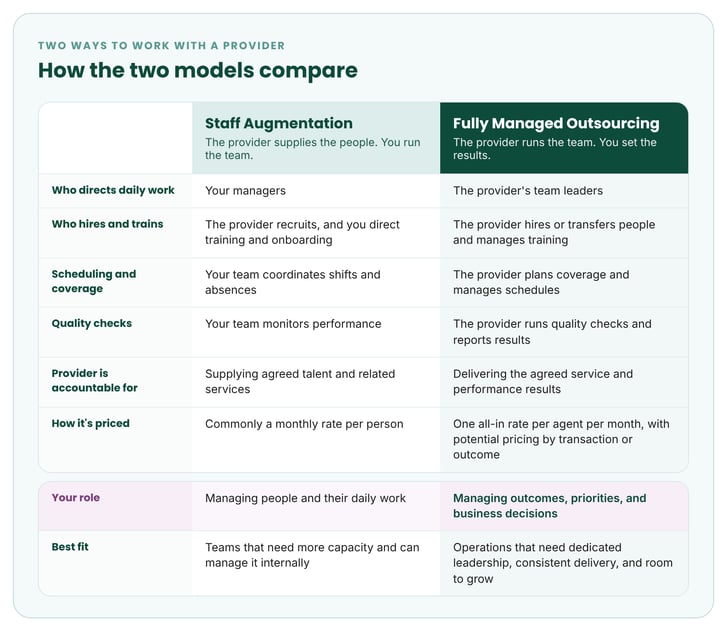
The transition between these models deserves more attention than a change in contract or reporting lines. Rush the handover, and you risk losing what your current hires know, watching service metrics dip, and losing leadership's confidence before the new arrangement has a fair chance.
Plan it well, and customers should notice little more than a team that keeps doing its job.
The move has three phases. First, the provider builds the team and its operating plan. Next, the team takes on live work gradually while performance is checked. Finally, once delivery is stable, the focus shifts to improving results.
Before You Start: Three Decisions to Make
1. Confirm the work has outgrown Staff Augmentation
The clearest sign is this: does someone on your side now spend most of their working time running the offshore team?
Other signals include coverage across several shifts, steep hiring plans, and roles that need to be filled in a rush to keep service levels on track. You may have started with a few individual contributors, but the operation now needs dedicated leadership, scheduling, training, and quality control.
Staff Augmentation can still be the right model when you need skilled people and have the internal management capacity to support them. The question is whether that arrangement still fits the scale and complexity of your operation.
For more on these signals, read our posts on when operations becomes the bottleneck on growth and how to hire and scale the right team in the age of AI.
2. Decide what moves and what stays
Start with work that's repeatable, high-volume, and measurable, because that's where a managed team does its best work. Keep work that changes significantly from week to week or relies on judgment your internal team is best placed to exercise.
Depending on your industry, that could mean moving:
- Healthcare: patient support and billing questions.
- Ecommerce: order management, returns, and customer support.
- Finance and accounting: accounts payable, accounts receivable, and collections.
- Logistics: freight invoice checks and shipment paperwork.
- Staffing and recruiting: CV processing and interview scheduling.
You can keep strategic decisions, unusual escalations, and work that requires close input from internal leaders.
Running Staff Augmentation and Fully Managed Outsourcing side by side can be a sensible long-term arrangement. For example, a managed team might handle routine customer inquiries while augmented specialists handle complex cases under your direct leadership. The goal is to match the management model to the work, not to move everything for the sake of having one model.
3. Choose a partner that owns the results
Ask providers which results they're accountable for, how they report performance, who leads the team, and what happens when service levels drop. Then ask to see last month's report from a live account, with confidential details removed.
Look for reports that show results against targets, explain changes, and name owners for follow-up actions. You should be able to see what's working, what needs attention, and who's responsible for fixing it.
Outcome-based pricing means you're charged for the results the team delivers, such as a rate per resolved ticket or processed invoice, instead of a rate per person on the team. A provider that owns results should be open to it, because it puts more of the delivery risk on the provider and aligns its financial incentives with your goals.
That only works if results can be verified. Ask who checks the work and how quality is measured. If the same AI that handles the conversations also grades them, it's marking its own homework.
In our customer support programs, that check comes from RubriCore, our AI quality engine, which scores every conversation against the client's own rubric.
Quality scores are useful when they lead to action. Ask how findings inform coaching and process fixes, and how the provider tracks those actions through to completion.
Finally, agree on what "resolved" means. A support ticket should count as resolved when the customer has a complete answer they can act on, not simply because the ticket has been closed. Define the result clearly before tying pricing to it.
The Transition to Fully Managed Outsourcing, Phase by Phase
Before you sign anything, agree on what the provider will take over, what success looks like, and how the handover will work. The details matter more than a generic transition plan.
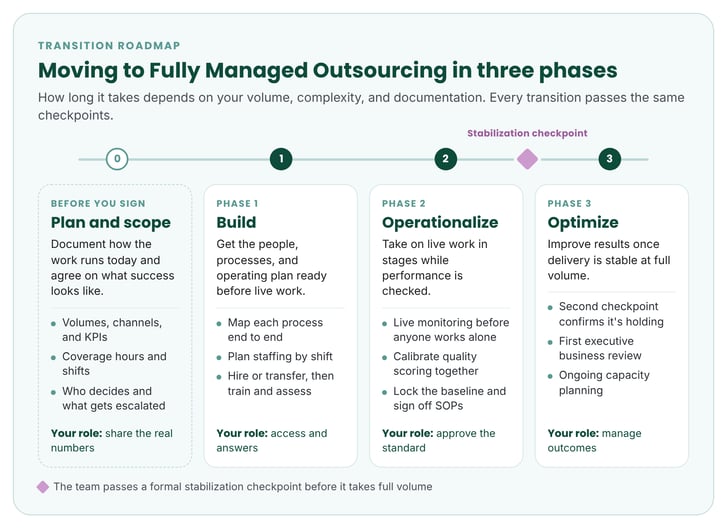
Before you sign: plan and scope the work
Start by documenting how the operation runs today. Give the provider a clear view of the actual workload, not just the job descriptions.
Include:
- Work volumes: how many tickets, calls, invoices, or other tasks the team handles, including peak periods.
- Channels: where work arrives, whether through chat, voice, email, or another channel.
- Monthly KPIs: key performance indicators, or the numbers you use to measure success, such as response time, accuracy, quality, and customer satisfaction.
- Forecast volume: expected changes in demand, seasonality, hiring plans, and new work that may come online.
- Coverage requirements: the hours, shifts, weekends, and holidays the team needs to cover.
Build a staffing plan around your actual operating hours. A team handling US customer inquiries needs a different coverage plan from one processing invoices during a fixed business day.
Agree on who makes decisions, how performance will be reported, and which issues need to reach your internal leaders. These arrangements are often called governance, meaning the rules for decisions, accountability, and escalation.
At Booth, our operations team joins discovery to understand the work and agree on the transition plan. The agreed timeline goes into the proposal after we've assessed the volume, complexity, and documentation available.
Phase 1: Build the team and prepare the handover
The first phase is about getting the people, processes, and working arrangements ready before the provider takes responsibility for live delivery.
Start with the knowledge your current team already has. Document the steps involved in each task, the exceptions people encounter, the decisions they make, and the situations they escalate. Written instructions help, but they rarely capture everything an experienced employee knows.
A Rotterdam School of Management study of IT outsourcing transitions by Tiwari (2010) found that the strongest transition performance came when the incoming team observed the work being done. For simpler tasks, written manuals performed about as well. The practical lesson is to match the handover method to the complexity of the work. Read the study.
From there, agree on the operating plan:
- Map the processes. Document the workflow from the moment work arrives through completion and escalation.
- Set decision rules. Define what team leaders can resolve independently and what requires client approval.
- Plan staffing by shift. Match the number of people and their skills to expected demand.
- Hire or transfer the team. Confirm responsibilities, reporting lines, and the skills required for each role.
- Train and assess readiness. Use process walkthroughs, practice cases, and supervised work to confirm that people understand the requirements.
The provider should also identify what it still needs from you. That could be access to internal tools, approval for a policy exception, or time with a subject matter expert who understands a complicated process.
Don't treat training as complete simply because everyone attended the sessions. The team needs to demonstrate that it can perform the work to the required standard.
Phase 2: Operationalize the work in stages
Once the team is prepared, it starts handling live work in controlled stages. This is where the transition plan meets actual customers, deadlines, and exceptions.
Begin with a manageable portion of the workload. Keep experienced people available to review work, answer questions, and step in when an issue falls outside the team's authority.
Nobody should work independently until their accuracy has been demonstrated under live monitoring. The provider and client should also calibrate quality scoring together, meaning they review the same examples and agree on how the scoring criteria apply.
Before increasing volume, establish a baseline for the measures that matter:
- Quality: whether work meets your standards.
- Customer satisfaction: how customers rate their experience.
- Speed: how quickly the team responds to or completes work.
- Accuracy: how often tasks are completed correctly.
- Cost per task: what it costs to complete a unit of work.
Record the starting figures and agree on the targets. Without a baseline, you can't tell whether the managed model has improved performance or simply changed who reports the numbers.
Document the approved process in standard operating procedures, or SOPs. These are the agreed instructions for completing work, handling exceptions, and escalating issues. The client signs off on the procedures before the team takes on the full workload.
The phase ends with a stabilization checkpoint, a formal review to confirm that the team can handle the agreed volume and maintain acceptable performance. Check quality, coverage, outstanding issues, and readiness to increase volume. If the team isn't ready, address the gaps before moving forward.
Phase 3: Optimize performance after the handover
When the team passes stabilization, the focus shifts from proving it can do the work to improving how well it does it.
A second checkpoint confirms that performance is holding under normal operating conditions. The first executive business review then sets the improvement roadmap, with priorities based on the results and the business goals you agreed on.
This is also where capacity planning, or forecasting how many people and what skills the operation will need, becomes part of the ongoing service. The provider uses volume trends, staffing requirements, and performance data to recommend changes before a predictable increase in demand becomes a coverage problem.
Your role changes, too. Instead of managing individual schedules and coaching sessions, you review performance, set priorities, approve material changes, and decide what the operation needs to achieve next.
That shift should be visible in your calendar. If you're still handling routine staffing gaps and reviewing individual work every day, the provider may need clearer authority, better processes, or more time to take full responsibility.
Planning a transition? Talk to our team. During discovery, we'll review your current operation, identify what should move, and map a transition timeline around your needs.
What Happens to Your Existing Offshore Hires?
Your current employees have knowledge that took time to build. They understand your customers, your internal tools, and the exceptions that never quite make it into a process document. A transition plan should account for that experience.
There are three common options.
Move them into the managed team. Existing employees can transfer into the new operating model, retaining their knowledge while moving under the provider's day-to-day leadership.
Keep them as augmented specialists. If some roles require direct oversight from your internal team, those employees can stay under Staff Augmentation while the provider manages the repeatable work.
Redeploy them. You may have people whose skills fit another function or a different set of responsibilities. Explore those options before assuming every role needs to change.
Tell your team about the transition early. Explain why the operating model is changing, what will change in their roles, who will manage them, and how decisions will be made. Give people a way to ask questions and raise concerns.
That communication matters to the business, too. Gallup has reported that replacing an employee can cost between one-half and two times their annual salary, depending on the role and circumstances. Losing experienced people during a transition can create additional recruitment costs and leave the incoming team with less operational knowledge. Read Gallup's research.
If your hires already work with Booth through Talent Solutions, our talent acquisition and Employer of Record service, they can move into a Booth managed team without changing employer. That creates a path from individual hiring to managed delivery without treating your existing team as disposable.
Running the Managed Team After Go-Live
Go-live is the beginning of the operating relationship, not the end of the transition plan. The provider needs a regular way to report performance, address problems, and agree on changes with your team.
A review cadence keeps conversations focused and gives the right people a role in decisions.
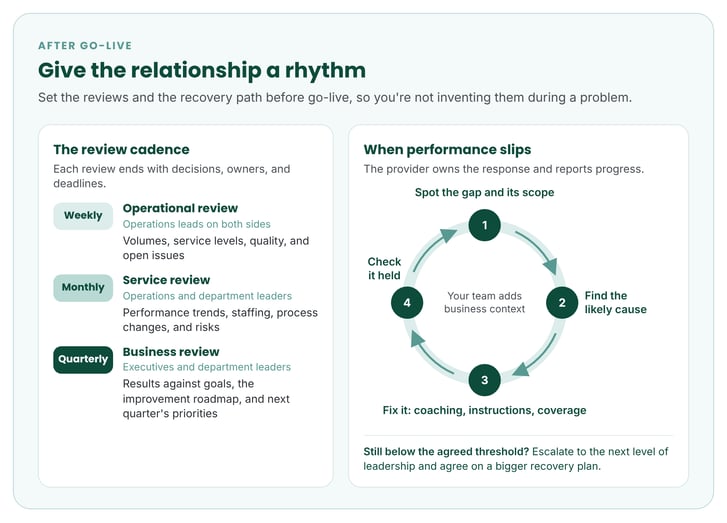
The weekly review handles immediate delivery questions. The monthly review looks at patterns that may require changes to staffing or processes. The quarterly business review connects those operating results to broader business priorities.
Each review should end with clear decisions, action owners, and deadlines. Otherwise, the same problems tend to return to the next meeting wearing a different hat.
What happens when performance slips?
Agree on a recovery process before you need one.
First, identify the gap and establish its scope. Is quality falling across the team, or is one type of task causing errors? Is the service level down because of higher demand, staffing gaps, or a process change?
Next, the provider should identify the likely cause and propose corrective action. Depending on the problem, that could mean targeted coaching, revised instructions, changes to shift coverage, or additional quality checks. Your team contributes business context and approves decisions that affect policies or customer commitments.
Set a review point to check whether the fix worked. If performance remains below the agreed threshold, escalate to the next level of leadership and agree on a more substantial recovery plan.
The provider should own the response and report progress. You should not have to discover the problem yourself and then manage the provider through every corrective step.
How managed outsourcing pricing can change
Managed teams usually start on one all-in monthly rate per agent. At Booth, that rate covers the agent, the team lead, quality reviews, and coverage for leave, so management isn't billed separately. The rate depends on where the team is based (the Philippines or Colombia) and the skills and languages each role needs. A one-time recruitment fee per agent and a one-time setup fee for your account apply when the team is built, and contracts start at one year.
Once the program clears its stabilization gate and there's reliable performance data, the engagement can move to transaction or outcome-based pricing, such as a rate per resolved ticket or processed invoice. Your cost then tracks the volume and the results rather than the headcount.
The right structure depends on the work, the quality requirements, and how clearly an outcome can be measured. A low price per task doesn't mean much if errors create rework or customers need to contact you again.
AI is another factor worth discussing when you review pricing. Deloitte's 2024 Global Outsourcing Survey found that 83% of more than 500 surveyed leaders were using AI in their outsourced services. Ask providers to explain where automation changes the work, how they measure the results, and how those changes affect your costs. Read Deloitte's survey.
Our article, If AI does half the work, what am I paying for?, explores how to think about the value behind an outsourcing fee.
Five Mistakes that Derail the Switch
Even a sensible transition can struggle when the operating details get overlooked. Watch for these common mistakes.
1. Skipping the baseline. If you haven't recorded current quality, speed, customer satisfaction, and cost per task, you won't have a fair comparison after the transition. Capture the starting numbers before live work moves.
2. Going live without checkpoints. A training completion date doesn't prove that the team is ready. Use live monitoring, agreed quality thresholds, and a formal stabilization review before moving to full volume.
3. Treating it as a staffing change. If the provider supplies people but you still manage their daily work, you've bought Staff Augmentation with a different invoice. Define who owns scheduling, coaching, quality checks, and corrective action before the contract starts.
4. Going quiet with your current team. Uncertainty creates room for rumors and unnecessary turnover. Tell people what is changing, explain the reasons, and give them a clear path to discuss their roles.
5. Stepping back too soon. Moving to managed delivery doesn't mean you stop reviewing results. Stay involved in priorities, business decisions, and service reviews while the provider takes responsibility for daily operations.
The common thread is preparation. A provider can take on management responsibilities, but the transition still needs informed decisions and active participation from your side.
Moving from Staff Augmentation to Managed Solutions with Booth
Whether your offshore team is with Booth through Talent Solutions or with another provider, the move to Managed Solutions follows the same four steps. It keeps your people and what they know in place, and shifts the day-to-day running of the team to us. Our teams work from the Philippines and Colombia, matched to your time zone and the languages your customers speak. If your team is currently employed through another provider, we can move them to Booth without a gap in pay.
- Map the work. Our operations team joins discovery to understand your volumes, channels, coverage hours, and the KPIs you track today.
- Agree on the plan. We build a staffing and coverage plan around your actual hours, and the agreed timeline goes into the proposal.
- Build and train the team. We hire or transfer the people the team needs, including any current Talent Solutions hires, who stay with Booth as their employer, and train everyone on your processes.
- Go live in stages. The team takes on live work as accuracy is proven, passes its stabilization checkpoint, and then moves onto a weekly, monthly, and quarterly review rhythm with your leaders.
From there, Booth runs recruiting, training, scheduling, capacity planning, quality assurance, and performance management as an extension of your team. You set the direction and keep the final decisions, and you manage the operation through one set of reports and one point of contact.
Tell us how your team works today, and we'll map what should move, build a coverage plan, and put the timeline in a proposal. See how Booth's Managed Solutions work or talk to our team to get a quote.
Frequently Asked Questions
What is Fully Managed Outsourcing?
Fully Managed Outsourcing is a model where a provider hires or transfers employees, trains them, manages schedules, checks quality, and leads daily operations. You agree on the expected results, review performance, and retain control of business policies and final decisions.
How long does a transition to Fully Managed Outsourcing take?
It depends on the work volume, complexity, and quality of the existing documentation. A straightforward process with clear instructions may move faster than a complex operation with multiple channels, shifts, and escalation paths. Booth confirms the timeline during discovery.
Will we lose control of the work?
No. You retain control of business priorities, policies, customer commitments, and major decisions. The provider takes responsibility for daily team management and delivery against agreed targets. Clear decision rights and escalation rules help maintain that balance.
Is there a minimum team size?
The right team size depends on the work, coverage requirements, and management needs. Rather than assuming a fixed minimum, discuss your current workload and growth plans with the provider to determine whether managed delivery makes operational and financial sense.
What should a Managed Services contract include?
Your contract should define the scope of work, performance targets, reporting requirements, responsibilities, pricing, staffing and coverage expectations, escalation procedures, and service review cadence. It should also explain how changes are approved, how underperformance is addressed, and how either party can end the agreement.
How does pricing change after the transition?
Managed teams often start with one all-in monthly rate per agent. At Booth, it covers the agent, the team lead, quality reviews, and coverage for leave. Once performance stabilizes and output can be measured reliably, the arrangement may move to transaction-based or outcome-based pricing, such as a fee per resolved ticket or processed invoice. The appropriate model depends on the work and the agreed quality standards.

About the Author:
Booth is a people-first outsourcing and talent solutions company that helps growing businesses build and manage remote teams across the Philippines, Colombia, and beyond. A Certified B Corp, member of 1% For The Planet, and Change Climate certified, Booth pairs skilled talent with transparent, accountable execution to deliver growth without compromise.


