
Year Six with The Climate Label: What We Measured, Funded, and Changed

We've earned The Climate Label again. Here's what went into our 2025 footprint, where our climate funding went, and the plans we're still working through.
The Climate Label is a certification run by The Change Climate Project, a nonprofit. To earn it, a company measures its cradle-to-customer emissions every year, applies an internal fee to every tonne, funds projects that cut emissions inside and beyond its value chain, and publishes reduction plans that are independently evaluated. Booth has earned The Climate Label every year since 2021.
We've earned The Climate Label for the sixth year in a row. Our profile on The Change Climate Project's site shows every number behind it.
Recertifying took months of work to measure our 2025 footprint, fund climate projects in proportion to it, and track the plans we set last year to reduce it. Any company can take these steps, and the more companies that take them now, the faster emissions come down.
Six years of measuring has taught us that electricity in our Philippine offices is one of our biggest sources of emissions, and clean energy options there are near non-existent for us. We haven't solved that yet. But we'd love to be able to figure that out someday.
-Jamie Booth, Co-founder, Booth
We're proud to stand with the hundreds of companies that have earned The Climate Label and are taking measured climate action today.
Why a Services Company Measures Its Footprint
A services company's footprint sits in its offices, its equipment, its commutes, and its travel. Ours grows as our teams grow in the Philippines and Colombia, and that's exactly why we measure it every year.
It matters to the people we work with, too. More clients now ask for a credible climate framework in their RFPs, and new teammates regularly tell us our sustainability work is one of the reasons they applied. Growth without Compromise has to include the planet, or it doesn't mean much.
Four Steps We Repeat Every Year
We work with the Change Climate team to measure our total footprint, set time-bound reduction plans, and fund a Climate Transition Budget that meets The Climate Label Certification Standard. Every certified company works to the same standard. For us, it comes down to four steps.
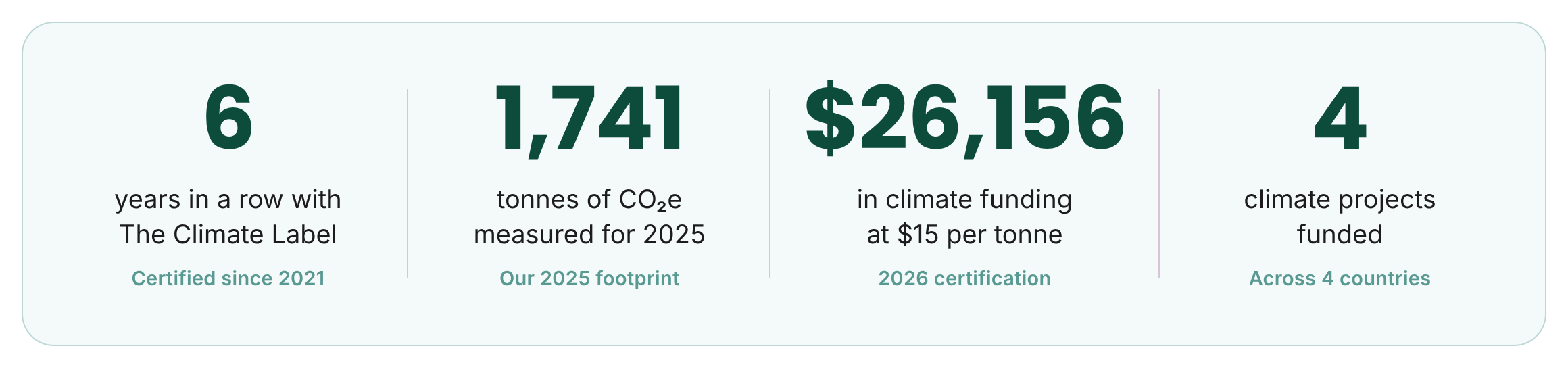
1. Measure - We measured our 2025 footprint at 1,741 tonnes of CO₂e. That covers everything it takes to deliver our services, from office electricity (430 tonnes) to commuting, equipment, and business travel (1,311 tonnes). It’s down from 2,344 tonnes the year before, and down per teammate from 1,375 kg to 1,058, a drop that comes from the reduction work below. One good year doesn’t make a trend, so we’ll keep reporting the number every year, whichever way it moves.
2. Fund - The Climate Label Certification Standard sets a fee of $15 on every tonne, which puts our Climate Transition Budget at $26,156. The standard splits that budget three ways, and here’s where ours went:
-
-
Beyond our value chain ($19,621): four vetted projects through CNaught, covering landfill gas capture in Liling, China ($8,836), methane abatement in Louisiana, USA ($5,883), peatland protection in Katingan, Borneo ($3,922), and regenerative farming in Karnataka, India ($980).
-
Within our value chain ($2,618): renewable energy certificates for our own electricity
- Other contributions to the transition ($3,917): guided support on Change Climate's emissions platform and part of our sustainability team's time
-
This is the first year we've spread our project funding across a portfolio. Buying renewable energy credits locally in the Philippines has been hard, and relying on one multi-year project carries real risk if it falls short. CNaught gives us a mix of vetted projects, each rated by independent agencies, with regular reporting on how they're doing. We treat these credits as funding for climate work beyond our walls, alongside the cuts we're making inside them, and never as a way to erase our own emissions.
3. Reduce - We find our emissions hotspots and set time-bound plans to cut them. Most of that work looks like lightbulbs and laptops. Since 2021, our teams have finished these:
-
- LED lighting across our offices, and LED only at our newest office
- Laptops kept in service for 5 years instead of 3, and 50% of our equipment donated to local communities
- Refurbished computers, monitors, and IT equipment as our default purchase
- A purchasing policy that aims to raise local purchases to at least 25%
- Fewer employee commutes to the office
- Less single-use company swag, with alternative prizes and giveaways for our teams
Three plans are still in progress: an energy management system to cut electricity use by 10% (60% complete), a 5% recycling rate for office waste (87% complete), and moving 20% of onboarding kit costs to digital (80% complete). For 2027, we've added two more: defaulting to virtual meetings with approval required for flights, and moving our Makati teams out of co-working space and into our 107 Aguirre office, which raises our space utilization by 20%.
But the bigger job is reducing what we produce in the first place. Commuting accounts for about half our footprint, followed by office electricity.
The certification makes us show our work. Every plan we publish comes back the next year with a completion percentage next to it, and that keeps all of us honest.
-Michelle Malonzo, Director of Impact & Sustainability, Booth
4. Advocate - We publish our numbers, finished plans and unfinished ones, so anyone can hold us to them. We back the wider movement as a Certified B Corporation™ and a member of 1% for the Planet, and we use our own channels, including this post, to show other companies what measured climate action looks like in practice.
What The Climate Label Means for the People We Work With
The Climate Label is an independent standard for climate action. Every certified company measures its cradle-to-customer emissions, funds climate solutions for every tonne, and reports its progress in public each year.
Consumers hold incredible power to shape the economy, and their power is exerted through the actions of the brands they support. With our climate label, we're helping consumers find companies that are taking action today and immediately investing in climate solutions.
-Austin Whitman, CEO, The Change Climate Project
Booth is part of a community of hundreds of certified companies, alongside brands like Klean Kanteen and MiiR. For our clients, it means a partner whose climate claims are checked every year. For our teammates, it means the company they work for answers for its footprint in public.
Ask What Your Partners Have Measured
Climate action moves faster when more companies treat it as part of doing business. Next time you choose a partner, a supplier, or an employer, ask what they've measured and what they've done about it. Ours is public, and we'll keep updating it.
Measured. Funded. Reported. Again next year.
Want every number behind this post? See Booth's profile on The Climate Label →
Frequently Asked Questions
What is The Climate Label?
The Climate Label is a certification from The Change Climate Project, a nonprofit. Companies earn it by measuring their cradle-to-customer emissions each year, applying an internal fee to every tonne, funding projects that cut emissions inside and beyond their value chain, and publishing reduction plans that are independently evaluated.
How long has Booth held The Climate Label?
Booth first certified in 2021 and has recertified every year since. The 2026 certification is Booth's sixth year in a row.
What was Booth's carbon footprint in 2025?
Booth measured 1,741 tonnes of CO₂e for 2025: 430 tonnes from Scope 2 electricity, 1,311 tonnes from Scope 3 sources such as commuting, equipment, and travel, and zero from Scope 1. That's 1,058 kg per full-time employee.
How does Booth fund climate projects?
The Climate Label Certification Standard sets a $15 fee on every tonne a certified company emits. For Booth’s 2026 certification, that created a $26,156 budget, which funded four vetted projects through CNaught, renewable energy certificates for Booth’s electricity, and internal sustainability capacity.
Does The Climate Label mean Booth is carbon neutral?
No. The Climate Label isn't a carbon-neutral or net-zero claim, and it doesn't mean Booth has zero climate impact. The Climate Label shows that Booth measures its full footprint every year, funds climate work in proportion to it, and follows published plans to reduce it. The work is ongoing.
About the Author:
Booth is a people-first outsourcing and talent solutions company that helps growing businesses build and manage remote teams across the Philippines, Colombia, and beyond. A Certified B Corp, member of 1% For The Planet, and Change Climate certified, Booth pairs skilled talent with transparent, accountable execution to deliver growth without compromise.


