
How PE-Backed Companies Can Grow EBITDA Without Cutting What Works

The first board meeting after a deal closes has a particular feeling. The slides are new. The people are new. And the profit number on the plan is bigger than anything the old owners asked for.
If you run a company owned by a private equity firm, you know the meeting I mean. The plan needs more profit every year, and it needs it on a schedule. The obvious ways to get there are also the ones that hurt. You freeze hiring. You cut a team. You ask the people who are left to absorb the work.
Sometimes that's the right call. A lot of the time it quietly breaks the things that were working, like response times, quality, and the people who knew how everything fit together. The profit shows up for a quarter or two. Then customers notice.
There's another option that doesn't get talked about enough at the operator level. Move one function to a dedicated team that someone else builds and runs, keep control of the standard, and keep the option to bring it back in-house later. This piece walks through when that works, when it doesn't, and how to pick the first function so you don't learn the hard way.
Why Is It Harder for PE-backed Companies to Hit EBITDA Targets?
Short answer: The market does less of the work now. A typical private equity deal needs roughly 10% to 12% EBITDA growth a year to return 2.5 times the money, about double what it needed in 2015, and owners are holding companies closer to seven years.
The pressure on PE-backed companies is real, and it isn't your board being unreasonable. The math changed.
Private equity firms make money by buying a company, growing it, and selling it for more. For a long time a lot of that growth came from the market itself. Interest rates were low and prices for companies kept rising, so a firm could sell for a higher multiple than it paid even if the business only improved a little.
That tailwind is mostly gone. According to Bain's 2026 Global Private Equity Report, a typical deal in 2015 needed about 5% annual growth in EBITDA (roughly, operating profit) to return 2.5 times the money over five years. Today it needs something closer to 10% to 12%. Bain also found that average holding periods have drifted toward seven years.
So the profit has to come from the business, and it has to keep coming for longer.
Meanwhile the biggest line on most P&Ls keeps going up. The Bureau of Labor Statistics reports that private-sector compensation costs rose 3.3% in the year to June 2026, and benefits rose 3.8%. If people are your largest cost, you're running uphill before you start.
That's the squeeze. Your owners need more profit, faster, for longer, and the cost of doing the work keeps rising.
What Does It Look Like When a PE-backed Company Moves One Function?
Short answer: The company keeps its clients, its standard, and its senior people focused on higher-value work, while a dedicated team handles the high-volume work that was eating their week.
Let me introduce you to a managed IT provider backed by a PE firm. The plan is a classic buy-and-build. The company buys smaller IT shops in nearby markets, rolls them up, and grows by adding their clients.
A few acquisitions in, the cracks show up in the same place every time. Each shop came with its own help desk, its own ticketing habits, and its own idea of after-hours coverage. Senior engineers spend half their week resetting passwords and chasing tickets. Overnight alerts go to whoever is on call, which usually means the person who most needs sleep. Hiring more US technicians would fix it, at a cost the plan can't absorb.
The CEO looked at the obvious moves. Cutting a few roles would help the margin and make coverage worse. Freezing hiring would do the same thing more slowly.
So the company moved one function instead. The tier-one help desk, system monitoring, and after-hours coverage went to a dedicated offshore team that an outside partner built and ran. The team worked in the company's tools, to the company's standard, under the company's name.
What stayed home mattered just as much. Client relationships stayed with the account managers. Security decisions and sign-off on changes stayed with the senior engineers. Anything that needed someone on site stayed local.
What the First Months Looked Like
The first surprise was documentation. Every acquired shop did things a little differently, and most of it lived in people's heads. Writing it down for a new team was painful. It was also the first time the company had one way of doing things across all its locations, which made the next acquisition easier to fold in.
The second surprise was where the time went. Senior engineers got their weeks back for project work clients actually pay more for. After-hours coverage stopped depending on who was willing to answer the phone.
The third was less fun. People leave, offshore or not. When someone on the team gave notice, the handover plan mattered more than the replacement. The companies that do this well agree up front how a departure gets handled, who backfills, and how fast. The ones that don't end up scrambling.
What Didn't Change
The clients didn't see a different company. They saw faster answers at 2 a.m. The standard didn't change either. The company set it, and the partner was measured against it every week.
The company also kept the option to take the team in-house later, once the roll-up was big enough to justify its own operation. That option turns out to matter a lot to PE owners, and we'll come back to it.
This story is a composite drawn from several companies we've worked with.
Which Functions Should a PE-backed Company Outsource First?
Short answer: Start with work that is high volume, follows a repeatable process, and can be measured every week, like customer support, help desk, claims, order management, and transactional finance. Keep signed-off accounting, licensed roles, strategy, and relationship-driven work close to home.
The managed IT company didn't move everything. It moved the work that was high volume, followed a repeatable process, and could be measured. That's the test.
Before you move anything, ask four questions about it:
- Can you write down what good looks like? If the standard only exists in one person's head, you'll be moving a guess.
- Is there enough volume to keep a team busy? One part-time task doesn't justify a dedicated team. A queue that never empties does.
- Can you measure it every week? Response time, accuracy, backlog, customer satisfaction. If you can't see it, you can't manage it from a distance.
- Would a customer notice if it moved? If the honest answer is "only because it got faster," that's a good sign.
Here's how that usually sorts out: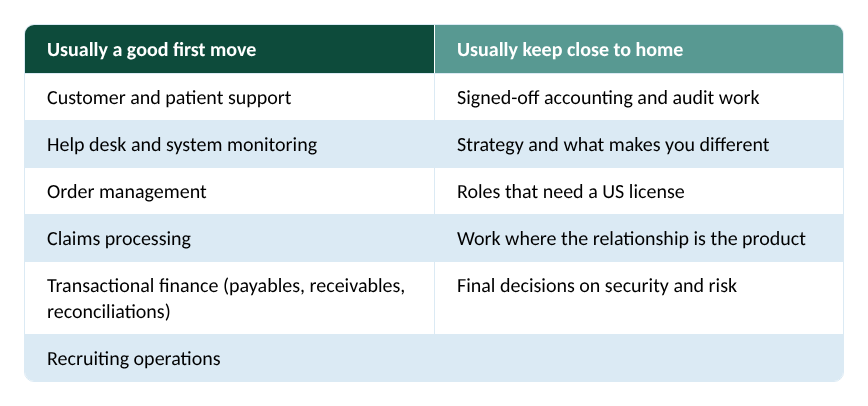
The right column isn't a list of things you can never move. It's a list of things you shouldn't move first. Notice that a function can split down the middle. In accounting, the prep work and reconciliations are a good first move, and the review and sign-off stay with your licensed people.
A good partner will tell you what they wouldn't move. If someone says yes to everything on the first call, that's a red flag. A good managed outsourcing partner starts with this conversation before anything else.
How Do You Keep Control of an Offshore Team?
Short answer: Set the quality standard yourself, agree on weekly KPIs before the team starts, ask how the partner keeps people, and write the option to bring the team in-house into the first contract.
The fear I hear most from operators is losing control. That's fair. You're accountable for the result whether the team sits down the hall or in Manila. So before you sign anything, get clear answers on four things.
Who sets the standard? You do. The partner should work from a written quality rubric that you help build, and it should be scored the same way every time. If the partner grades its own homework with no input from you, walk away.
Ask what sits behind the rubric, too. A strong partner builds quality assurance, coaching, and a learning plan for each person into the team from day one. Someone reviews a sample of the work every week, coaches the people who miss, and updates training when your process changes. If QA and coaching are an add-on you pay extra for, the standard will slip the first time volume spikes.
What will you see, and when? Weekly reviews for the day-to-day, monthly reviews for trends, quarterly reviews for the bigger picture. All of it against KPIs you agreed on before the team started. Surprises should be rare.
Will the people stay? Turnover kills offshore teams faster than anything else. Every departure costs you training time and quality. Ask what the partner's annual retention is, and ask what happens when someone leaves. The handover plan should be written down before you need it.
Can you take it back? This is the one PE owners care about most, and it's the one operators forget to ask.
What is Build-Operate-Transfer (BOT)?
There's a model called build-operate-transfer (BOT). A partner builds the team, runs it to your standard for a set period, and then hands it over to you, people and processes included.
A well-structured BOT has three phases with real dates on them:
- Build. Hiring and setup. Expect a couple of months to get people in seats and closer to five months to reach steady state.
- Operate. The partner runs the team against your KPIs. Give it at least 18 months before you talk about transfer. You want proof it works before you own it.
- Transfer. A fixed window, usually around six months, to plan the move and then make it. People should keep their tenure, leave, and benefits so nobody walks out the door in the handoff.
Why does this matter so much to your owners? Because it lets you cut the cost of third-party work now without locking the company into a vendor forever. When the business is bigger, or when a buyer wants to see the capability owned rather than rented, you can bring it inside. That's an easier story to tell at exit than a long outsourcing contract nobody can get out of.
What Should You Do Before Your Next Board Meeting?
You don't need a transformation program. You need one good first move and a way to show it's working. Here's where I'd start.
- List your three highest-volume functions. Put the monthly cost next to each one, fully loaded with benefits and management time. That's your shortlist.
- Run each one through the four questions. Can you write down the standard, is there enough volume, can you measure it weekly, would a customer notice? Cross off anything that fails two of them.
- Write the standard for the one that's left. One page. What good looks like, how you'll score it, and the three numbers you'll review every week. If you can't write this page, you're not ready to move it yet.
- Decide now whether you want it back someday. If the answer is maybe, build the transfer terms into the first contract. It's much harder to add them later.
- Bring the board a plan for one function, not a plan for the company. Owners trust a pilot with clear numbers more than a big promise. Show them the cost today, the cost after, and the date they'll see the first results.
If you want a second set of eyes on the shortlist, that's a conversation I'm always happy to have. Bring your list and we'll work through it together. No deck.
Frequently Asked Questions
What is build-operate-transfer (BOT) outsourcing?
Build-operate-transfer is a model where an outside partner builds a dedicated team, runs it to your standard for a set period, and then transfers the team, its processes, and its people to your company. It lets you get the savings of outsourcing now and own the capability later.
Should a PE-backed company cut headcount or outsource to hit its EBITDA target?
Cutting headcount lowers cost quickly but often hurts quality and coverage. Moving one high-volume function to a dedicated, well-managed team can lower cost while keeping or improving service levels. Many companies do a mix, but outsourcing one function first is lower risk than broad cuts.
What should a mid-market company look for in a managed IT or back-office outsourcing partner?
Look for a written quality rubric you help set, weekly KPI reporting, built-in QA and coaching, high annual retention, a documented handover plan when people leave, and the option to bring the team in-house later.
How long does it take to stand up an offshore team?
A dedicated team typically takes about two to three months to hire and onboard, and around five months to reach steady performance. Plan on at least 18 months of running it before you consider bringing it in-house.
Which work should stay in-house?
Keep work that needs a US license, final sign-off on accounting and audit, strategy, security and risk decisions, and any work where the customer relationship is the product.

About the Author:
Jen Spencer is the Chief Growth Officer at Booth, where she helps growth-stage companies build hybrid human-AI teams without compromising on quality, culture, or control. She's the author of Lead Anyway: How to Build the Career You Want When the Rules Weren't Written for You, a six-week workbook on reclaiming leadership in rooms that weren't built for you. Before Booth, Jen was the CEO of a 300-person digital agency. She advises and invests in early-stage SaaS, is a Pavilion member, and speaks on operations strategy in the AI era. Author. Operator. Recovering impostor.


