
Your Overtime Line is a Hiring Plan Nobody Approved

Overtime is cheaper than hiring for a short spike. Once it stays high for more than a quarter, it usually costs more. Divide a team's monthly overtime hours by about 150, the productive hours one full-time person delivers in a month. If the result is above one, you're paying a premium for headcount nobody approved.
In October, people on six of our client teams told us in their regular check-ins that they're carrying heavy workloads and working overtime most weeks. We haven't run the numbers on those teams yet. When we ran them on a similar team last year, the overtime turned out to be covering for four engineers the client had never hired.
On most P&Ls, overtime sits in the variable cost bucket. It goes up in a busy quarter, it comes back down, and everyone moves on. I don't see it that way anymore. If overtime has been high for more than a quarter, it's a fixed cost, and I count it as headcount. Nobody approved that headcount, and you're paying extra for it.
The Team that Looked Fine
Last year Kathy Ancheta and her operations team dug into an IT services client's engineering team. 29 engineers. Service-level agreements (SLAs) mostly met. Nobody is asking for more people. On paper, fine.
Then they pulled the time cards.
Ticket volume was up 48% from the back half of 2024 to the first half of 2025. Overtime was close to zero through late 2024. It started climbing in February, and by April it hit 726 hours in a single month. It stayed up through June and averaged more than 500 hours a month.
Each engineer gives you about 150 productive hours a month, and that's being generous. So in April, overtime was doing the work of almost five full-time employees (FTEs).
That's the whole calculation, and it works on any team:

The capacity model set aside 20% of paid time for shrinkage, which is the time people are paid but not working tickets. Leave, meetings, coaching, training, and breaks. It said the team needed 33 engineers. They had 29. That's a gap of four, not five, because overtime hours aren't fully productive. Overtime was covering the gap almost to the person. It was a four-person staffing decision, and it got made by default instead of in a budget meeting.
Is Overtime Cheaper than Hiring?
Overtime on that team ran a 30% premium under local labor rules. In the US, the floor is time and a half. So if you're reading this from a US P&L, your numbers are worse.
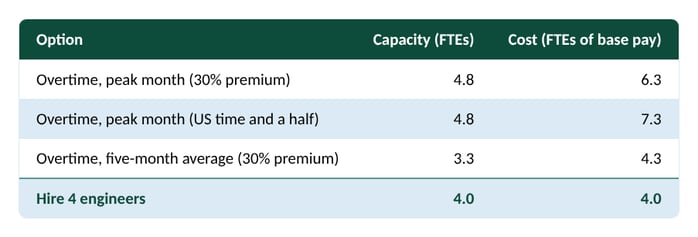
At the peak, the client was paying for more than six people to cover a four-person gap. At US overtime rates, it would have been more than seven. On average, it was roughly a wash.
I know what the finance folks reading this are thinking. New hires come with benefits. Fair. That narrows the gap. I'd still take the hires for two reasons.
First, overtime hours are the worst hours you buy. Research on working hours shows that past a certain point, output keeps rising but at a decreasing rate. You're paying a premium for your most tired hours.
Second, tired people leave. Gallup puts the cost of replacing one employee at half to two times their annual salary. Lose one senior engineer off a team that's been running hot for six months, and whatever you saved on overtime is gone.
Why Don't Dashboards Catch It?
The team's average handle time, meaning how long a ticket takes from pickup to close, looked great. About 95% of their tickets were low or moderate priority, and most closed in under an hour. Critical tickets took more than seven and a half hours each. Average those together and everything looks healthy.
Then there was one engineer who closed more than 3,000 tickets in six months, at 23 minutes each. Amazing. Also a little terrifying. That one person made the whole team look better staffed than it was. If they'd taken another job, the gap would have shown up overnight. That kind of key-person risk belongs on a CFO's risk register, and I'd bet it's not on yours.
What We Told Them
Hire three or four engineers.
If you're thinking, "Of course, the outsourcing company says hire," fair. More engineers on that team means more revenue for us. So don't take my word for it. Run your own overtime through the same math. If it comes out under one FTE, keep paying the overtime, and I'll tell you the same thing.
The rest was less exciting. Forecast demand monthly or quarterly so the next spike gets planned instead of absorbed. Stop handing out tickets by hand in the order they arrive, and route them by complexity. Set a handle-time standard for each priority level so you can see a team slipping before overtime tells you. That's everyday work for a managed operations team, and routing is where AI-assisted operations can take real load off people.
If we ran this analysis today, I'd look hard at how much of the routine volume AI could take first. About 95% of their tickets were low or moderate priority. The capacity math stays the same either way. It tells you how big the gap is before you decide whether people, AI, or both should fill it.
How to Calculate the True Cost of Overtime on Your Team
You can do most of this in an afternoon.
-
- Pull 12 months of overtime by team. Look for a step-up that never came back down. If it only spikes in peak season, overtime may be doing exactly its job.
- Take each team's average monthly overtime over the last 6 to 12 months and divide by about 150. If it's over one month after month, you have a staffing decision nobody made.
- Ask for handle time on critical work by itself, not blended in with everything else.
- Ask what share of the volume your top one or two people carry.
- Ask when someone last forecast demand. If the answer is "at budget time," start there.
Questions CFOs Ask About Overtime
What is shrinkage in workforce planning?
Shrinkage is the share of paid time people aren't available for their core work: leave, meetings, coaching, training, and breaks. The team in this post planned for 20%. Contact centers commonly run 25% to 40%. If your headcount plan assumes people work every paid hour, it's short before you start.
Is overtime a variable cost?
On most P&Ls, yes. It moves with hours worked, so it gets treated as a variable cost. The regular part is usually booked as direct labor, and the premium often goes to overhead. Overtime that stays high for months behaves like a fixed cost, which is why I count it as headcount.
How much overtime is too much?
There's no universal line. My rule of thumb: if a team's overtime adds up to more than one FTE and has stayed there for more than a quarter, treat it as a staffing decision. Seasonal spikes are different. Planned peak-season overtime is often the right call.
When should you hire instead of paying overtime?
When overtime has run high for more than a quarter, converts to at least one FTE, and your demand forecast says the volume isn't going away. Before you hire, check how much of the routine volume AI could absorb. Count benefits and shrinkage on the hiring side. Count the lower output of tired hours and the cost of turnover on the overtime side.
If you run the math on your own team and it surprises you, I'm happy to walk through it with you.

About the Author:
Jen Spencer is the Chief Growth Officer at Booth, where she helps growth-stage companies build hybrid human-AI teams without compromising on quality, culture, or control. She's the author of Lead Anyway: How to Build the Career You Want When the Rules Weren't Written for You, a six-week workbook on reclaiming leadership in rooms that weren't built for you. Before Booth, Jen was the CEO of a 300-person digital agency. She advises and invests in early-stage SaaS, is a Pavilion member, and speaks on operations strategy in the AI era. Author. Operator. Recovering impostor.


